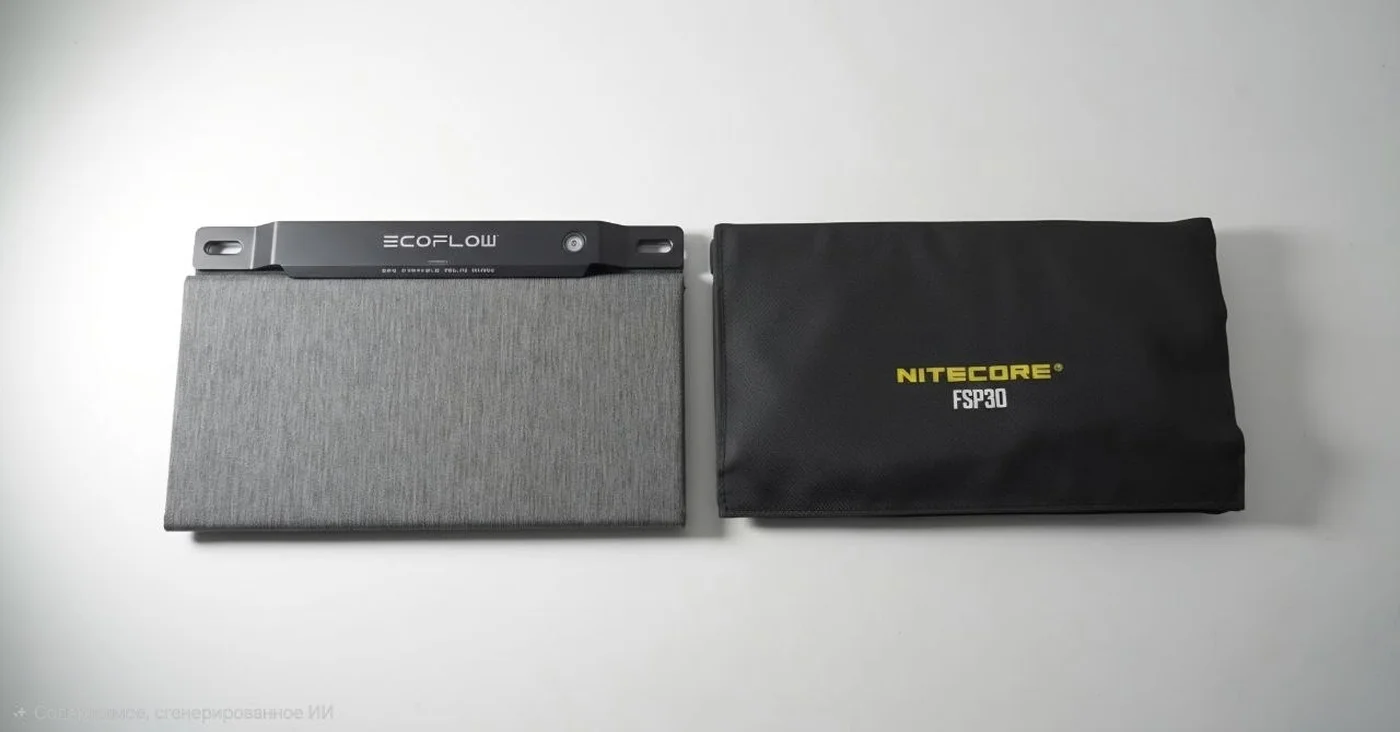

In this article we take a detailed look at a newcomer to the hiking solar panel market: the EcoFlow 28W. It weighs about 600 g, folds down to the size of a small book, uses efficient N-Type TOPCon cells with 25% conversion efficiency, and has built-in USB-C (up to 20 W) and USB-A (up to 26 W!) ports that support several voltages and lots of protocols. It also has a sun-angle indicator, is dust- and waterproof to IP68, and has an ETFE coating!
Build and design
The EcoFlow 28W is a folding panel made of four sections. Unfolded, they lie in a single row measuring 291 × 664 × 2 mm.
For comparison, the NiteCore FSP30 measures 295 × 880 × 4 mm (but its last section is a pocket for devices, with the controller inside).
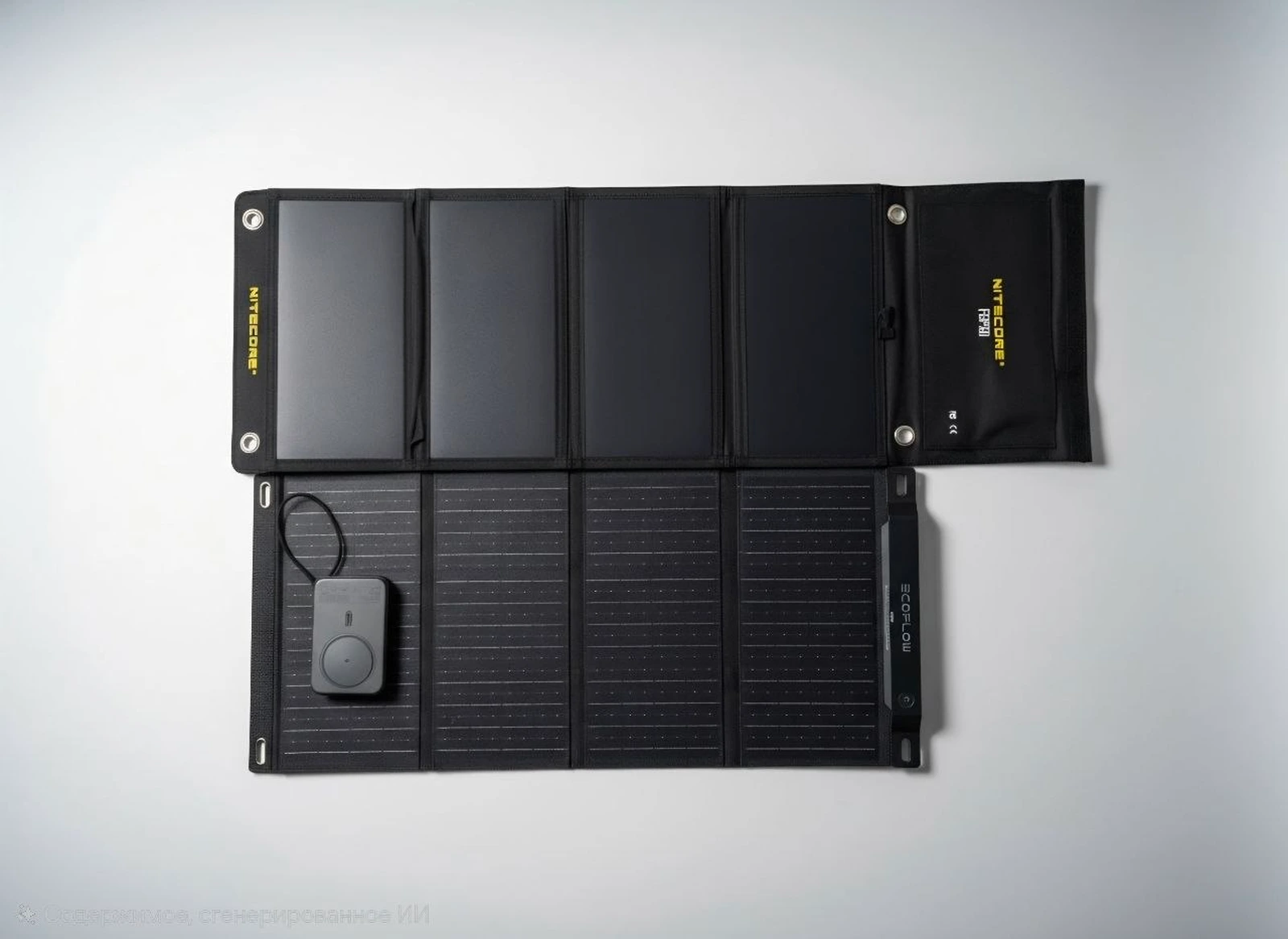
Folded, it shrinks to 291 × 177 × 18.6 mm.
The NiteCore folded: 295 × 170 × 45 mm.
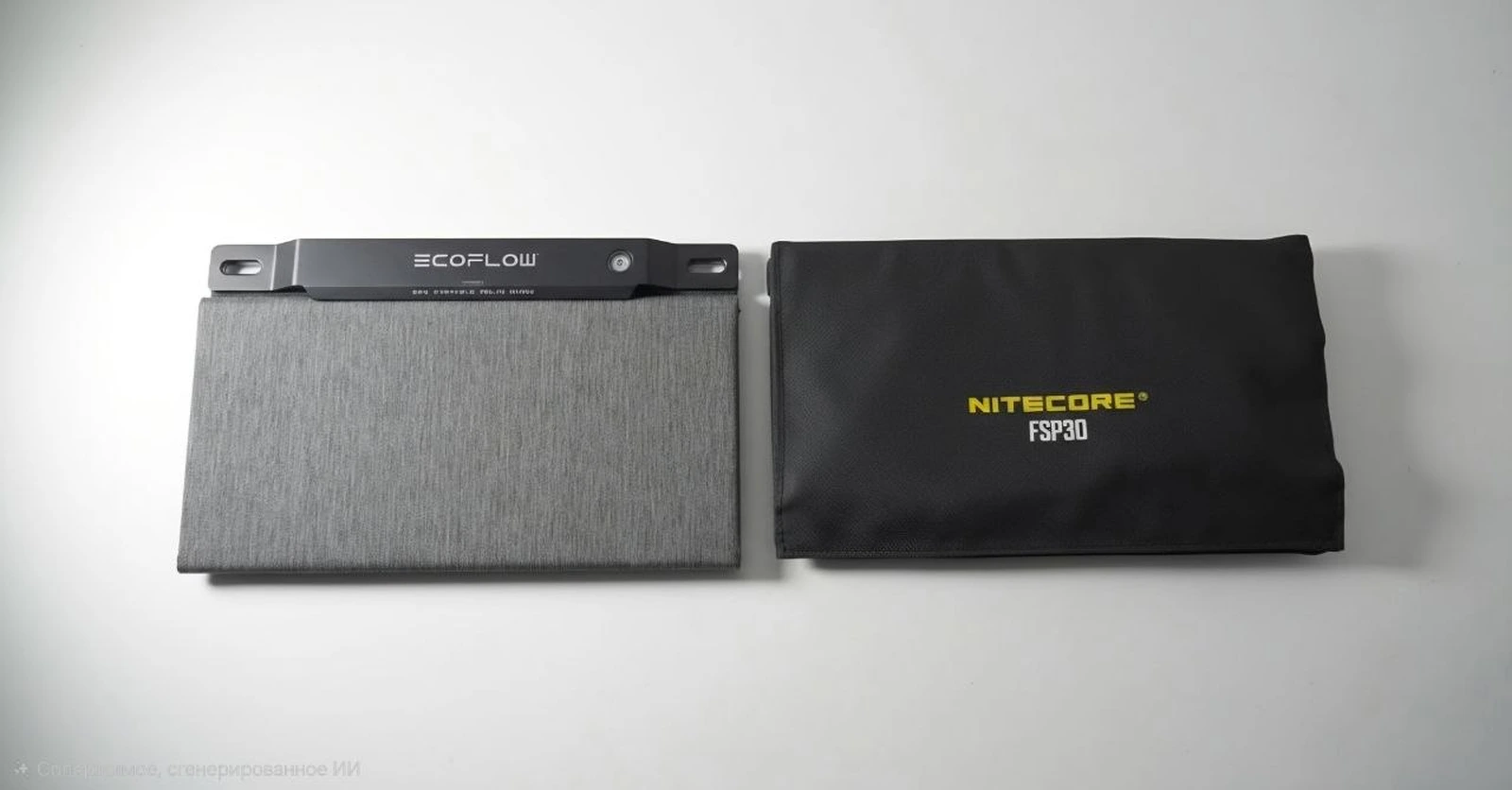
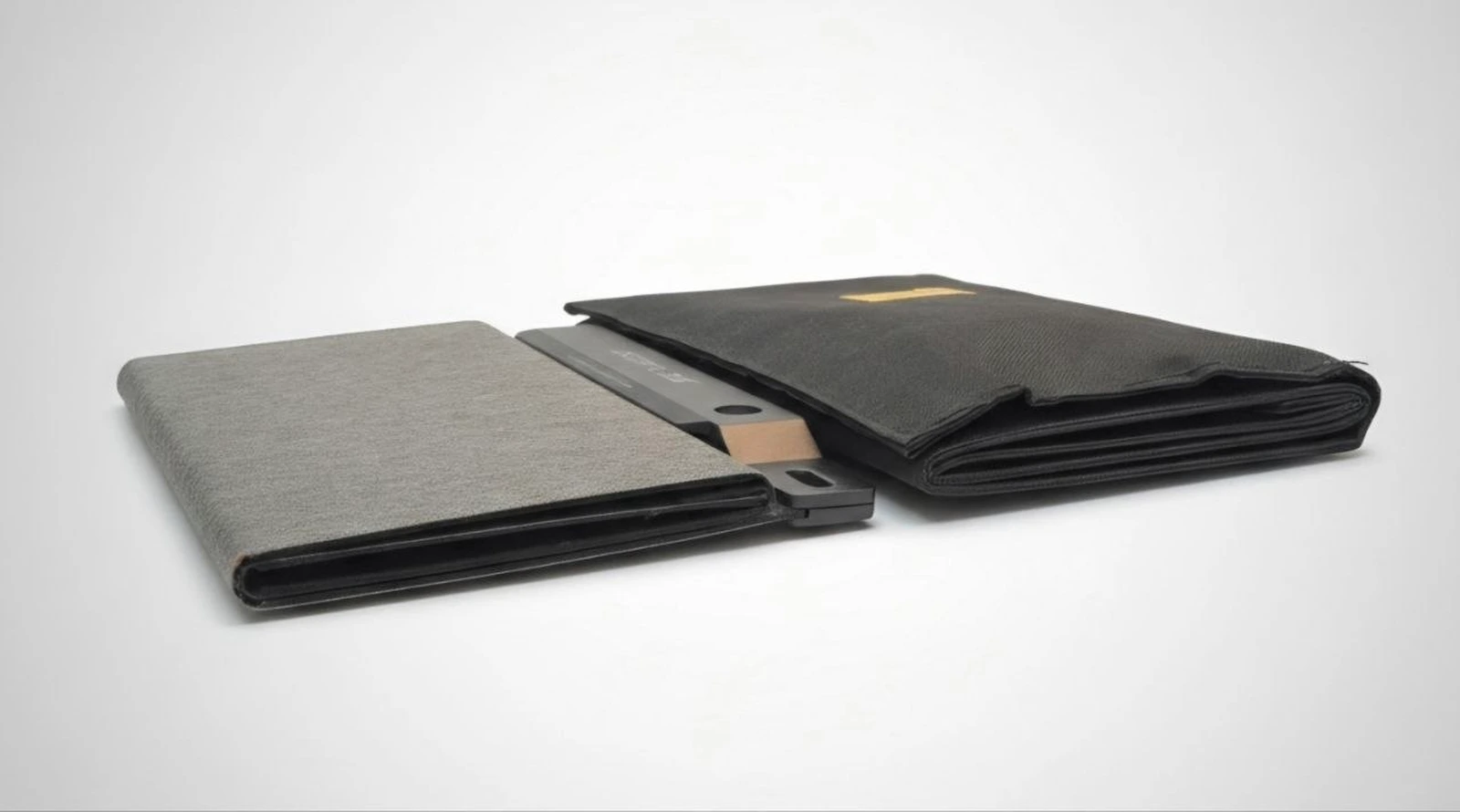
The panel weighs 600 grams.
The EcoFlow 28W is built as a thin multilayer composite laminate.
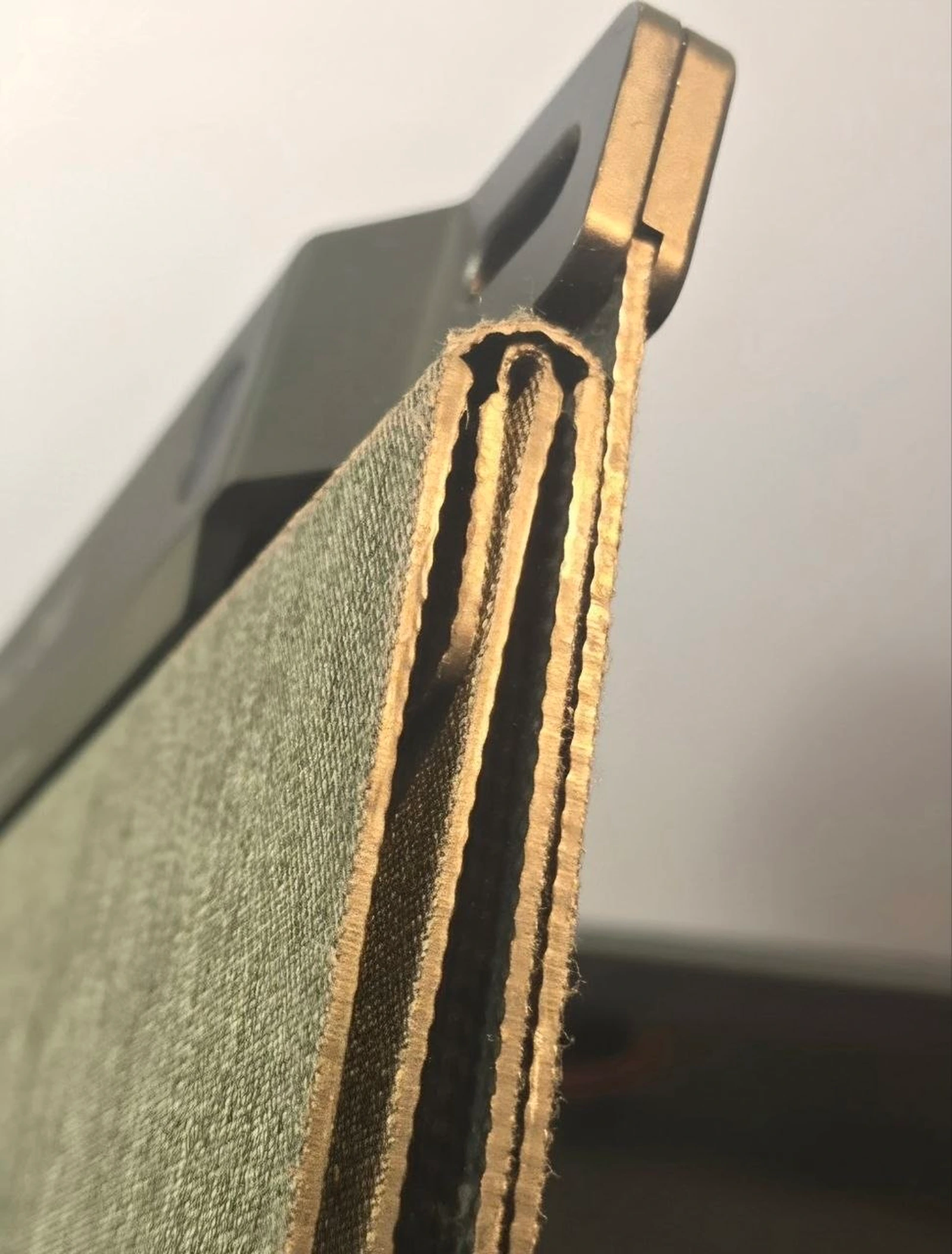
On top is a transparent protective ETFE layer. It lets sunlight through to the cells while protecting them from moisture, dirt, UV and mechanical damage.
Underneath, there is most likely a transparent encapsulation layer that holds the solar cells in place and bonds the top coating to the rest of the structure.
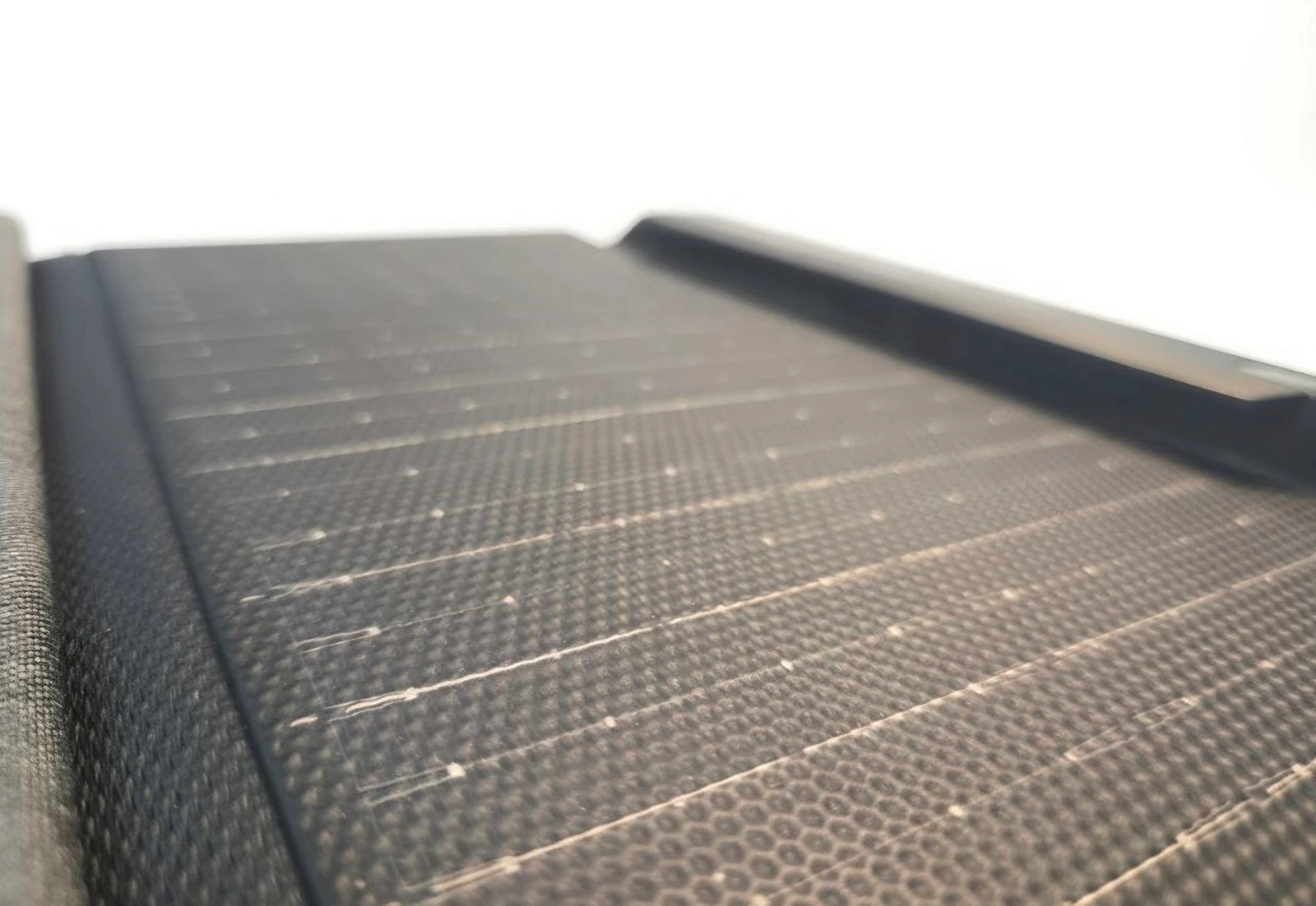
Next come the solar cells themselves. They are thin, fragile silicon wafers, so they need as much protection as possible.
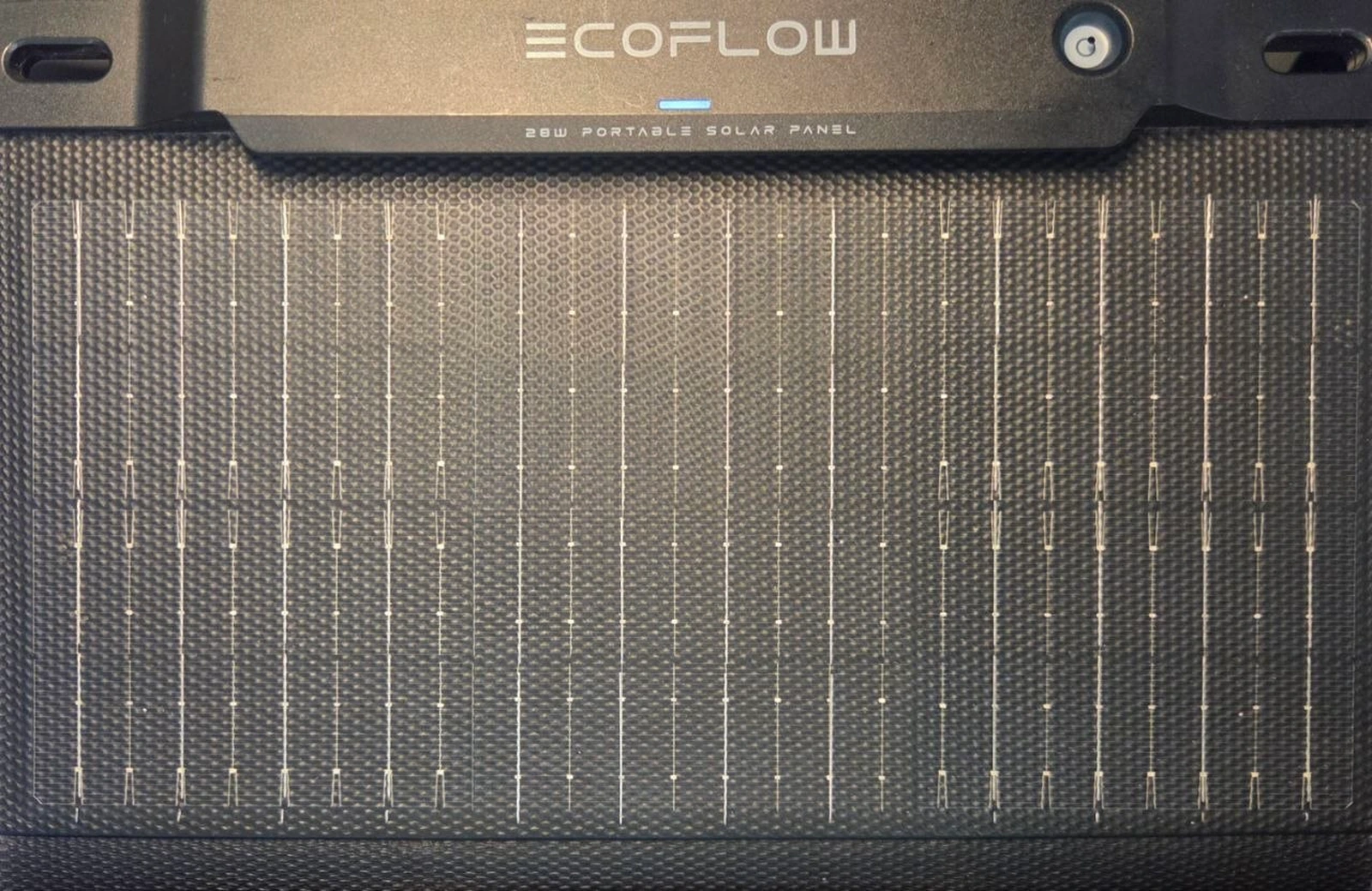
Below, they are covered by another encapsulation layer that keeps the cells in place and protects the electrical connections between them.
Most of each section's mechanical strength apparently comes from a thin fiberglass composite backing.
On the back, the structure is covered with a protective layer that hides the internals from view and feels nice to the touch (you can see it in the photo of the folded panel).
The panel folds along flexible joints between the sections. I won't claim this design is better than the NiteCore's, but it looks good, minimalist and well sealed (and fairly sturdy, even though it doesn't seem so at first).
The design is clearly built for portable use. There are eyelets along the edges for attaching the panel to a backpack, tent and so on (by the way, 4 small carabiners come in the box).
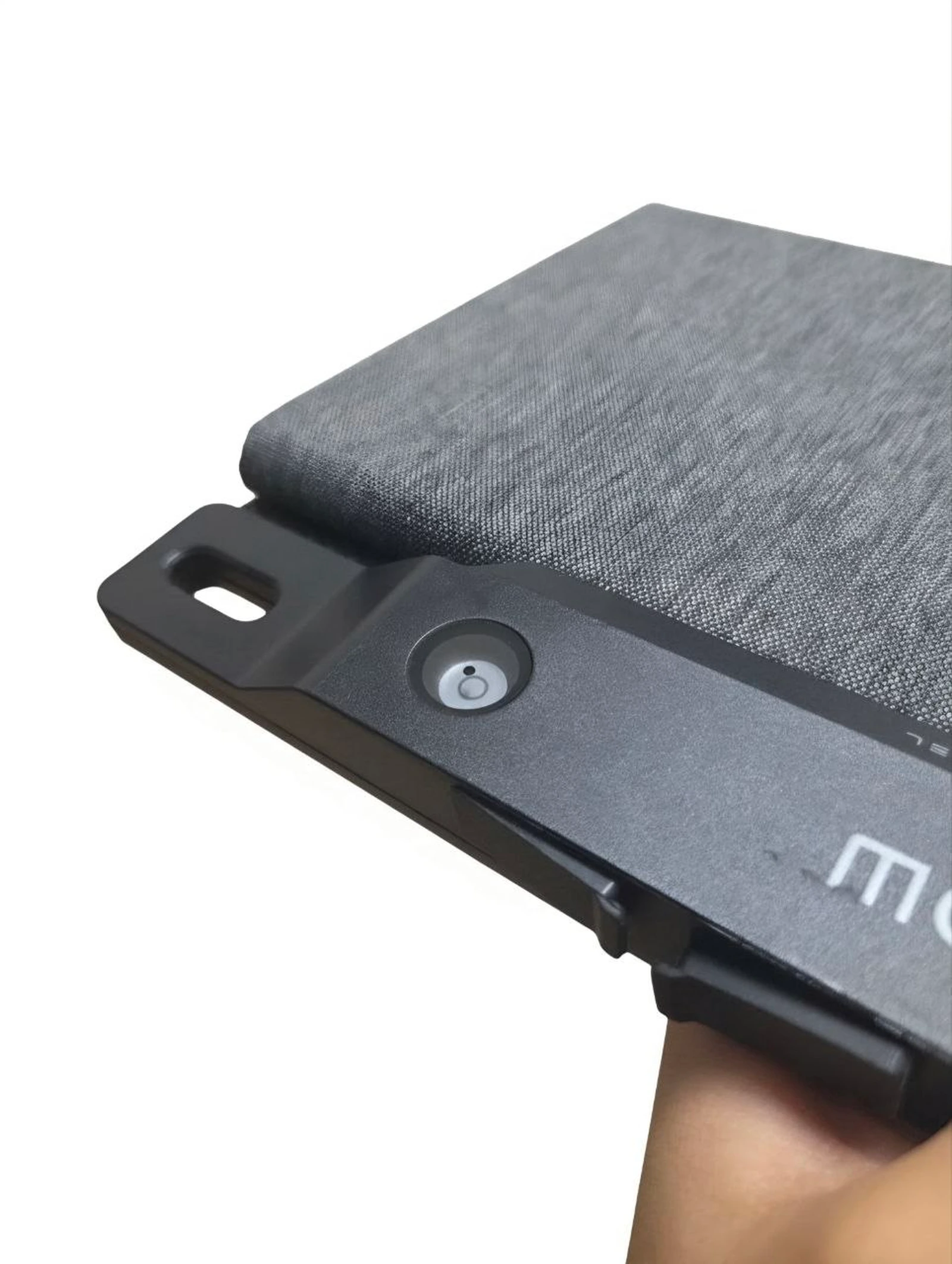
One of the end sections has a bulkier plastic housing. It holds the output ports and the panel's internal electronics. Only 2 ports are accessible from the outside, USB-C and USB-A, and both are covered with rubber plugs (it is IP68, after all).
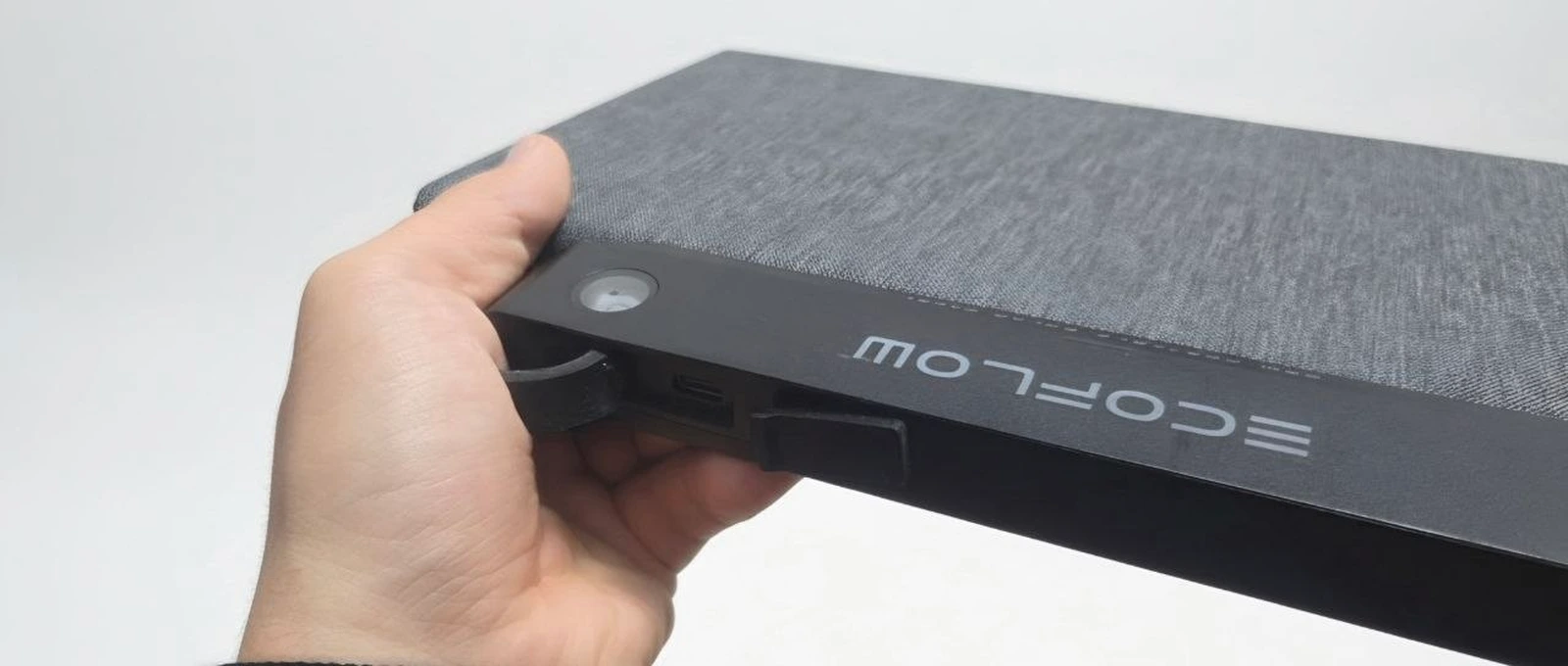
The charging unit has a built-in sun-angle indicator, an extremely handy feature! It lets you point the panel straight at the sun, which makes a big difference to output, and you don't have to guess whether you've positioned the panel correctly! There is also an LED, which isn't very useful overall.
ETFE coating
Many modern panels (unlike the NiteCore, for example, which uses PET) use ETFE (ethylene tetrafluoroethylene), a transparent fluoropolymer, as the outer protective layer. Naturally, the main job of the top layer is to let as much sunlight as possible through to the cells while protecting them from the environment.
ETFE has high light transmittance and is resistant to UV, moisture, temperature swings and chemicals. This makes it possible to build a thin, relatively flexible solar module, which is especially important for a folding hiking panel. ETFE also has good mechanical strength, on top of the already mentioned resistance to aging and its ability to keep its optical properties after long outdoor use.
{ PET, in turn, fades faster (not that critical for hiking panels, since they aren't in the sun all the time); PET is less transparent (around 85–90%), so part of the sunlight is lost, while ETFE transmits up to 95%; PET also melts or deforms when strongly heated (in case someone decides to iron their panel); and PET scratches more easily, is more sensitive to abrasives and is harder to clean. }
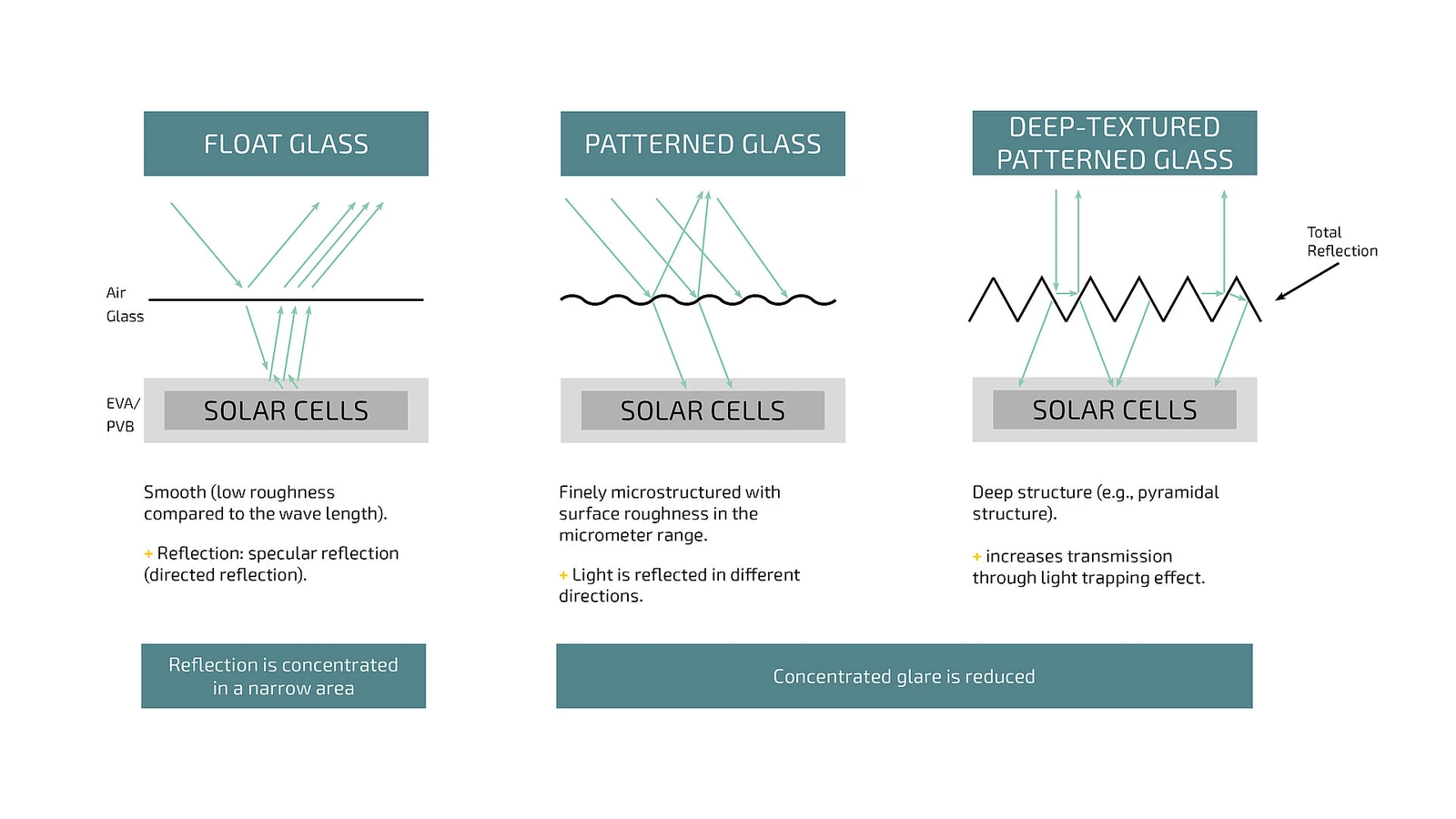
You may notice that many ETFE panels have a textured or matte surface. The texture helps reduce specular reflection (which is what we want) and scatters incoming light, so more of it reaches the cells, especially when the angle of incidence isn't ideal.
Solar cells
The EcoFlow 28W uses modern monocrystalline N-Type TOPCon cells with a claimed efficiency of up to 25%. Put very simply, their advantage is that less of the charge already generated by sunlight is lost inside the cell itself. As a result, you get a bit more useful power from the same area.
This matters a lot for a portable panel: the more efficient the cells, the less area you need for the same power. That's how EcoFlow managed to make the panel fairly compact.
For comparison, the NITECORE FSP30 uses SunPower cells with a claimed efficiency of about 24%. These are also high-quality, efficient cells, so the difference between the panels isn't huge. Rather, EcoFlow uses the more modern mass-market N-Type TOPCon technology, which is now widely used in high-efficiency solar modules.
Another advantage of N-Type cells is good resistance to performance degradation during long exposure to the sun. In particular, they don't suffer from one common type of light-induced degradation found in some traditional P-Type cells.
If you want to dig deeper, see Fraunhofer ISE's materials on TOPCon technology and scientific reviews of modern silicon solar cells: (Fraunhofer ISE) (Energies, TOPCon review)
Electronics
At first glance, you might assume the EcoFlow 28W works much like simpler hiking panels: the solar cells feed a DC/DC converter that produces the required USB voltages. For example, a teardown of the NITECORE FSP30 shows a relatively simple board with a few converters inside: a separate USB-C channel and a shared 5 V channel for USB-A, with no obvious energy storage or dedicated MPPT circuit on the board.
I'd venture that this panel is more complicated inside (with your tacit consent, I won't destroy the protective potting compound on the board to find out exactly what's installed).
Clue #1: the LIC
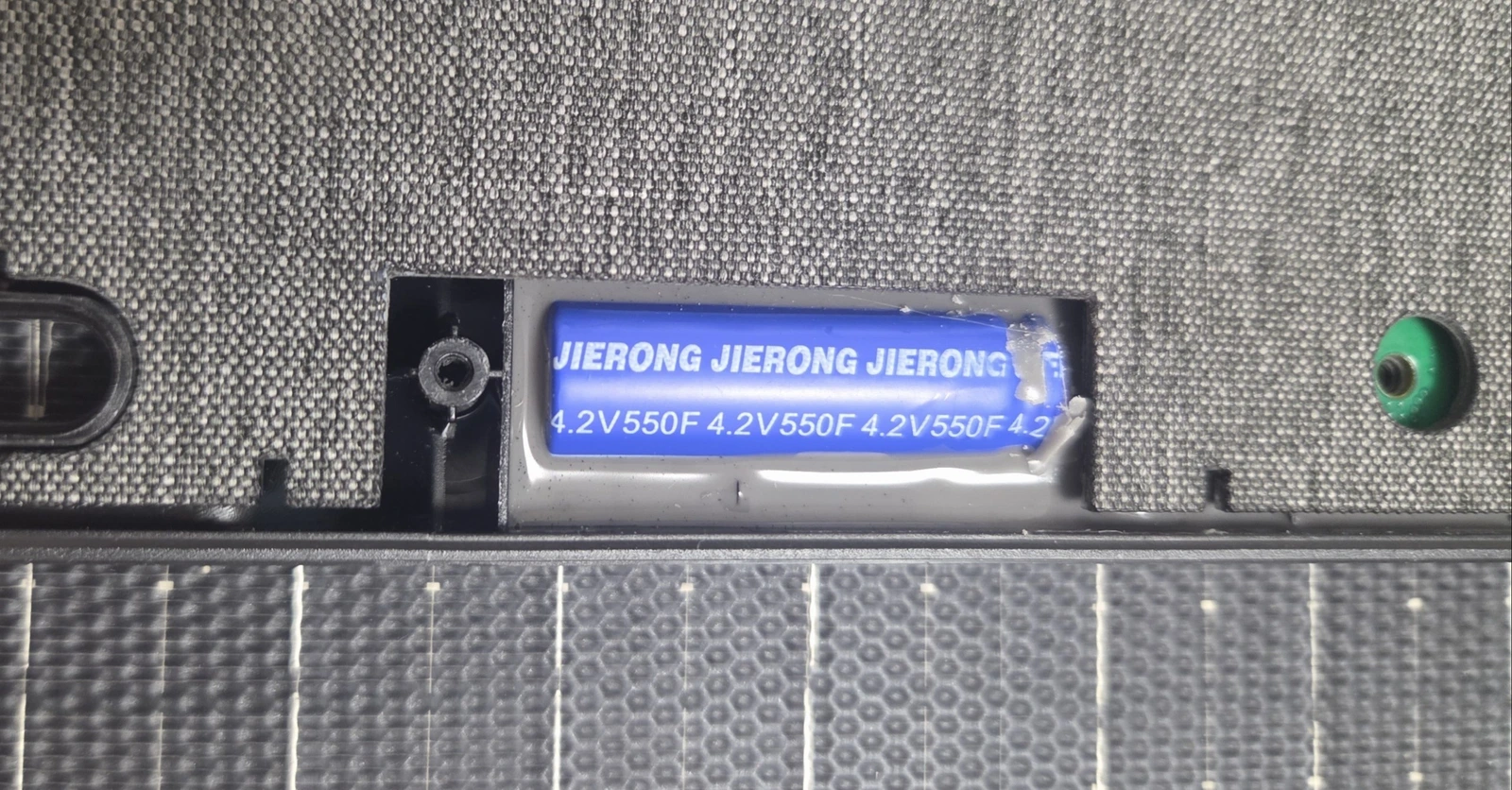
Naturally, as soon as I got the panel, I looked inside. The first interesting find was a JIERONG 4.2 V / 550 F supercapacitor. This is a lithium-ion capacitor, or LIC, which sits somewhere between a battery and a regular supercapacitor. With 550 F at 4.2 V, its theoretical energy capacity is about 1.35 Wh, although the energy actually usable is lower because of the allowed voltage range.
By the way, it can self-discharge and degrade, so I recommend topping it up periodically through the Type-C port.
For an ordinary USB converter, a component like this is clearly overkill, so I got curious about what role it plays. Note also that all the electronics are potted in a protective compound, which is what provides the IP68 rating (the NiteCore didn't even have conformal coating on its board).
To figure this out, I searched EcoFlow's patents and found application CN122119013A, published in 2026. It describes a device with a very similar purpose: a solar panel, a storage capacitor, a controlled power converter and a USB interface. The controller measures the power coming from the solar panel, monitors the storage capacitor's voltage, and depending on the energy available, chooses a suitable mode for powering the connected device. The patent specifically covers USB PD/QC, output voltages of 5, 9 and 12 V, and operation under sudden changes in solar power.
The logic of such a system is fairly clear. In good sun, the cells power the connected device and keep the storage capacitor charged at the same time. If a cloud, the shadow of a tree or a person covers the panel for a few seconds, solar power drops, and the shortfall can temporarily be drawn from the capacitor. During that time, the controller can reduce the charging power or negotiate a different charging mode with the phone over the charging protocols, without cutting power instantly. Charging instability under changing light is exactly what EcoFlow's patent names as one of the problems the storage capacitor solves.
It also helps make better use of short bursts of surplus solar power under changing light. For example, if the connected power bank can accept no more than 20 W, while at a good moment the cells can deliver 25–30 W, an ordinary panel simply leaves that extra power unused. In the EcoFlow, the surplus can go into the LIC. When a cloud then rolls in and the cells' output falls below 20 W, the storage starts feeding the saved energy back into the system. As a result, the power bank keeps receiving almost the same power for a while, and the short dip in light is smoothed out. In other words, the supercapacitor here is not just protection against charging dropouts but also a buffer that shifts part of the energy from moments of surplus to moments of shortage. (This is cool, by the way; you should be impressed.)
Clue #2: the solar panel's parameters
Specs for the EcoFlow 28W published by some sellers list a maximum-power voltage of about 7.5 V, a maximum-power current of about 3.64 A, and an open-circuit voltage of about 8.5 V. If these values are correct, the 4.2 V JIERONG storage cannot simply be connected directly in parallel with the solar cells. So either the actual circuit includes another intermediate converter, or the parameters given by the stores don't quite match this panel configuration, or the production EcoFlow 28W is built differently from the version in the patent.
Clue #3: behavior
I used the panel quite a lot over the summer and noticed something odd:
1) USB-C works not only as an output. If there's no light (the panel is covered) and you connect an external power bank to the Type-C port, the panel starts taking in energy and charging the internal LIC.
2) If you connect one power bank to USB-A and another to USB-C at the same time, the power bank on the USB-C port starts discharging and the device on the USB-A port starts charging. This points to a bidirectional path and possibly to power-path management logic, meaning the device can distribute power between an external source, the internal storage and the load.
This behavior is typical of dedicated power bank SoCs.
For example, the Injoinic IP5356 supports bidirectional USB-C PD2.0/PD3.0, 5/9/12 V modes, PPS, QC2.0/QC3.0, FCP, AFC, SCP and BC1.2, and combines charging of the internal storage with a synchronous converter in a single chip (Injoinic IP5356 datasheet). The iSmartWare SW6208 follows very similar logic. It supports bidirectional Type-C, PD/PPS/QC/AFC/FCP/SCP and other protocols, can charge the internal storage and power an external load at the same time, and when several outputs are active it switches them to a shared 5 V mode. This is especially interesting because the EcoFlow 28W behaves in a similar way when USB-A and USB-C are used together (iSmartWare SW6208 datasheet). More powerful chips of the same class exist at 30 W too. For example, the M12219P is designed for single-cell storage, up to 30 W, and supports PD3.0, QC3.0, AFC, FCP, SCP and BC1.2 DCP.
This doesn't mean the EcoFlow actually uses an IP5356 or SW6208; these are just examples that can illustrate and explain the observed behavior.
Based on these observations, here's what I think the internals look like:
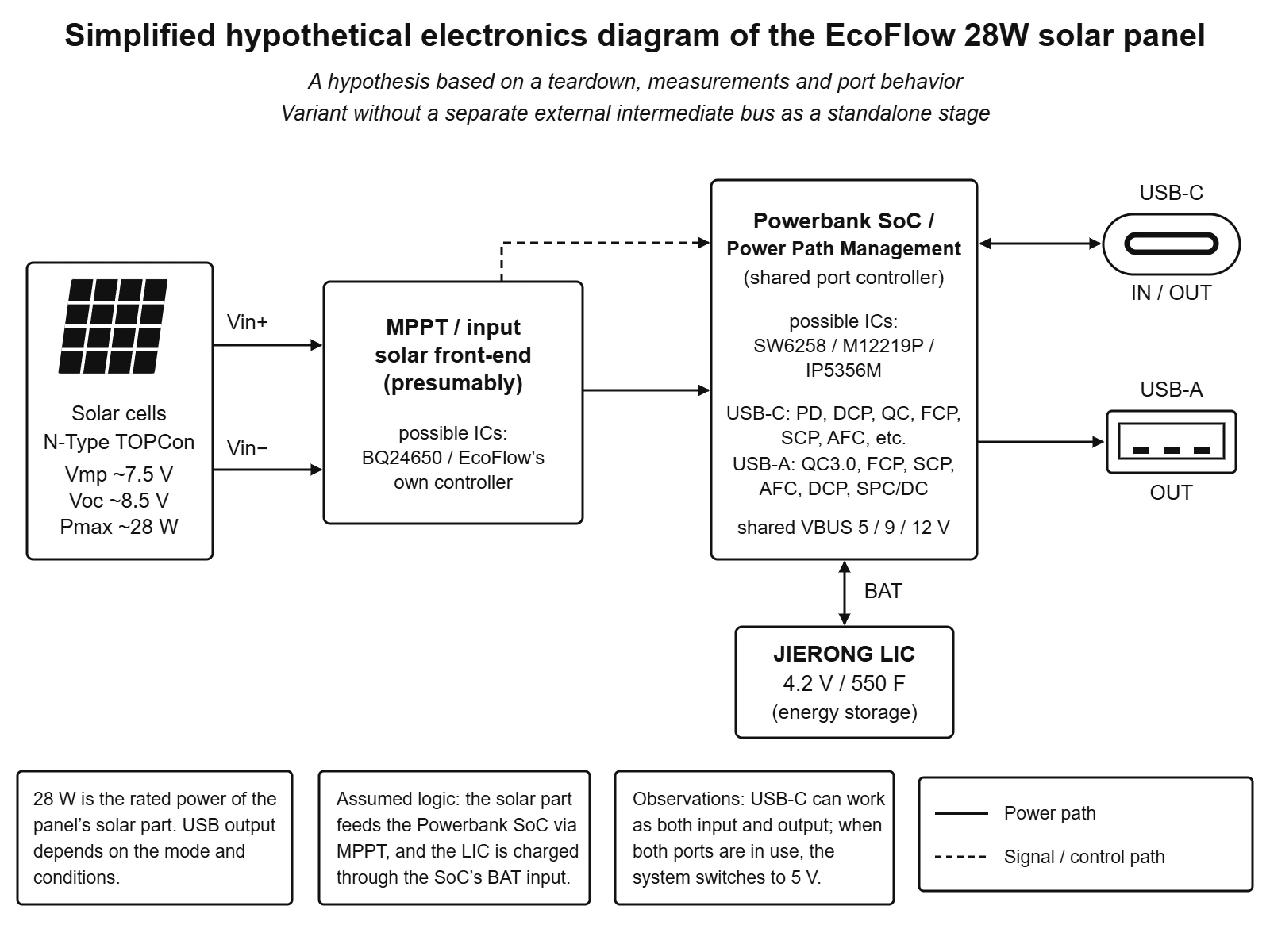
I assume the panel contains MPPT, since it delivers a stable current even in difficult conditions, and all of EcoFlow's patents involving an LIC use MPPT or similar algorithms. The LIC is connected to the power bank SoC, as clue #3 suggests.
Where the "28W" in the name comes from
Now let's figure out where the claimed 28 W comes from at all (same as with the NiteCore).
It isn't the USB-C power: that port is capped at 20 W, and USB-A is limited to 18 W (though by some coincidence it can deliver up to 27 W).
EcoFlow states directly that the solar part of the panel can deliver up to 28 W to the internal electronics, after which part of the energy is lost in the converters. For solar panels, the actual maximum power lies between these states, at the so-called maximum power point (MPP):
Pmax = Vmp × Imp.
Taking the values found in EcoFlow's specs:
Vmp = 7.5 V
Imp = 3.64 A,
we get:
7.5 × 3.64 ≈ 27.3 W,
which fits nicely within the manufacturer's stated 28 W ±1 W.
And now the most boring part: the ports
Officially, EcoFlow specifies 5 V / 3 A, 9 V / 2.2 A and 12 V / 1.67 A for USB-C, with a maximum of 20 W, and 5 V / 3 A, 9 V / 2 A and 12 V / 1.5 A for USB-A, with a maximum of 18 W. The manufacturer separately explains that the cells themselves can deliver up to 28 W to the internal electronics in the "junction box", and part of the power is lost in buck/boost conversion.
(Official EcoFlow 28W page)
By the way, the panel supports a huge number of fast-charging protocols!
The main USB-C protocol is USB Power Delivery (PD), providing 5, 9 and 12 V modes (there are also DCP, SCP and DC modes), and it immediately picked up PD3.0, which is arguably today's gold standard.
On USB-A, the tester detects Qualcomm Quick Charge 3.0 (QC 3.0), Huawei FCP, SCP, USB BC1.2 DCP and additional compatibility modes.
Thanks to this, the panel can do more than act as a plain 5 V source: it can negotiate a better-suited power mode with the connected device.
The NiteCore FSP30 has only one fast-charging mode, 9 V / 2 A on Type-C (PD), and 5 V / 3 A on Type-A.
But I have to disappoint you: there is a fly in the ointment. When both ports are used at the same time, the higher-voltage modes are switched off and the system falls back to a shared 5 V bus with a combined output of up to 14 W. This isn't a big problem, considering that most people only use one port anyway.
Tests
I ran lots of tests during my summer holiday: in Sochi, on hikes, and back in St. Petersburg at the end of summer. I'll show the most successful and telling ones, because I have a pretty big spreadsheet of them.
Let's start by finding the maximum power on the EcoFlow 28W's ports. According to the specs, the Type-C port maxes out at 20 W and Type-A at 18 W. But it turned out that Type-A can deliver 26 W.
Later the same day, I compared the NiteCore FSP30 with the panel under review in various modes. I have good reason to believe my NiteCore FSP30 is defective: on Type-C it doesn't deliver 18 W (I didn't get that even in Sochi with the sun blazing), as stated in the specs and as many other users get. So in the Type-C tests below I'll add 22% to its power (exactly what it's missing to reach 18 W) to keep things more or less fair.
Next, I tried to see how much the NiteCore loses at a non-ideal angle, since it has no ETFE coating.
As you can see, in the test with the panels lying on the ground, the NiteCore delivered few watts, while the EcoFlow, thanks to its coating or the extra headroom of its solar cells, delivered a stable result. The test table from the video above:

Next, a series of tests in cloudy weather:

Next, a series of energy accumulation tests:
What is that? I put both panels side by side, connect them to power banks and go off to sunbathe and swim, and after a while I check how much energy (mWh!!! mAh won't do, it doesn't measure energy) each panel has accumulated. Then I divide by the time to get the average power. This cancels out the supercapacitor's effect on instantaneous power and gets us closer to real-world use of the panels.
If you want the equivalent battery "capacity" in mAh, divide the accumulated mWh by the battery voltage, 3.6–3.75 V.
I'll show one video of what this looks like; for details, the tables are better, and not every test has a video:
By the way, here are photos of what I mean by variable cloud cover in Sochi:


Also keep in mind that my pain (broken testers that kept the panels from working properly) affected the results too, so they may have limited the output at times. Let's treat these tests as the minimum values you can expect in the field; I'd count more on 18–20 W average power in good sun. (Honestly, I tried to get accurate numbers; next time I'll use better testers, but more on that later.)


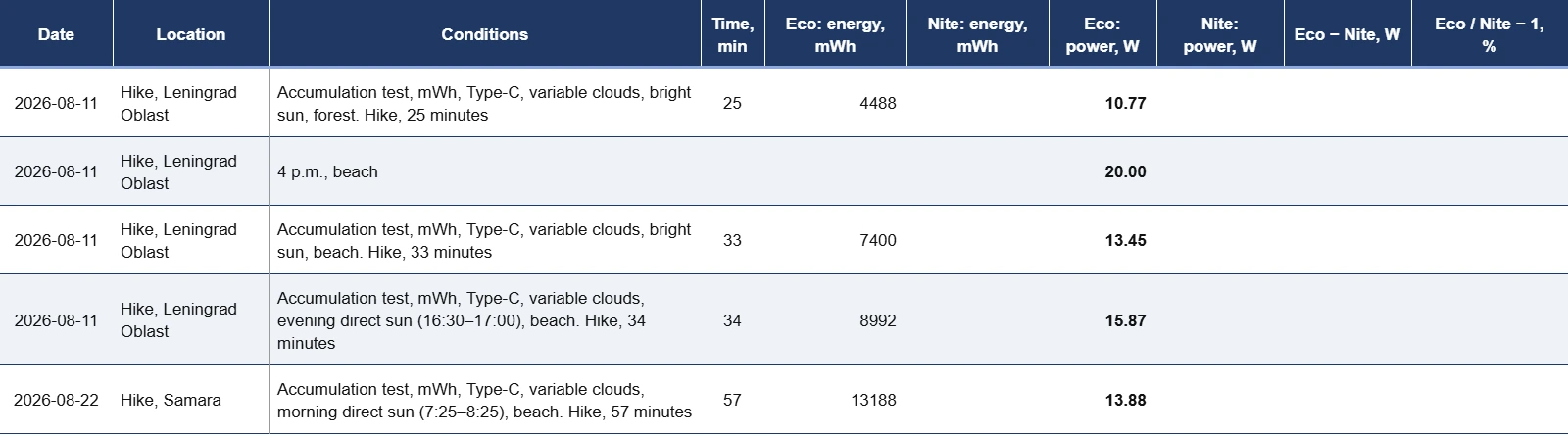
A few more tests (a fairly long and slightly chaotic video) at the end of summer, to give you more data and show how the panel behaves. It also shows my pain in these tests: USB testers die very quickly in the field.
I put the important, good data into a table:

What else to buy for a good experience with the panel
1) A good cable (Type-C or Type-A, your choice). It's convenient if it's at least half a meter long, better a meter, so you can put the power bank somewhere handy. The cable must support fast charging and the protocols discussed above (check it with a tester before the trip).
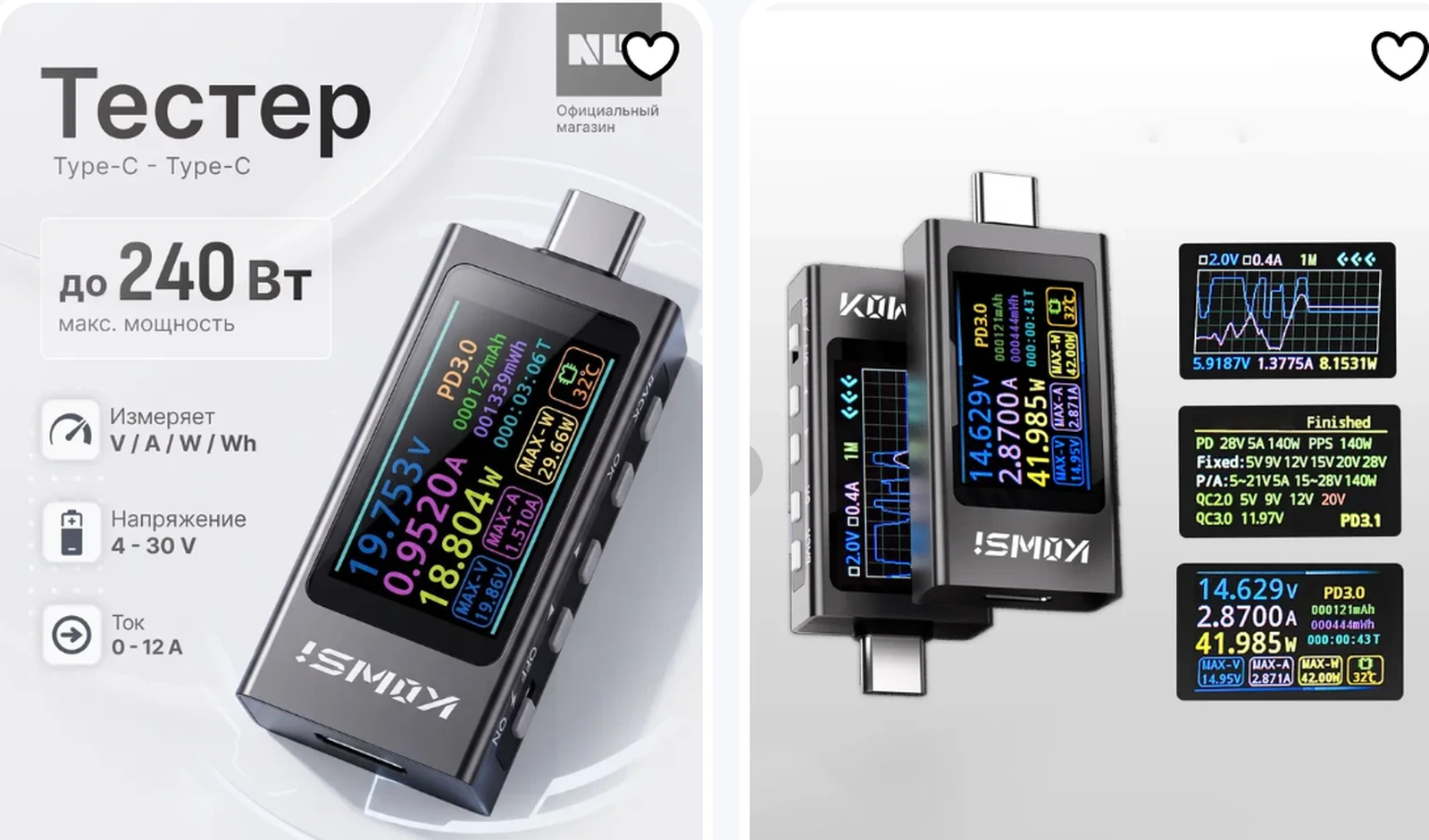
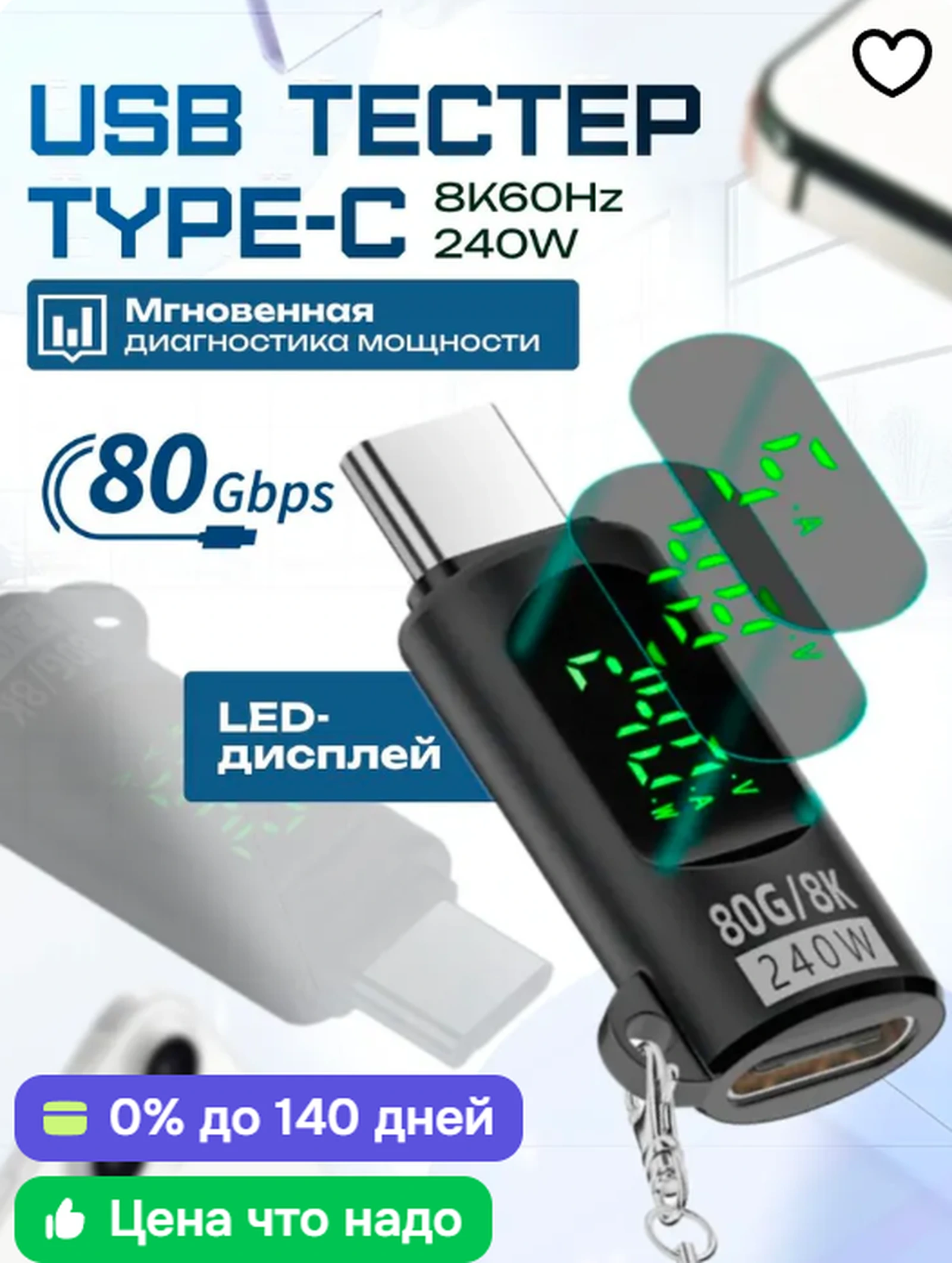
2) To see how much power is coming in at first, and to keep an eye on it, it's best to buy a USB tester. Power banks with a display that shows the charge are also common now (the preferred option, since it won't break and won't get in the way).
2.1) The KOWSI testers are fine for tests and comparisons like mine, but they die far too quickly, and I haven't found any sturdier alternatives.
There are also small ones like this that can show how much power is going into the power bank, and they're perfectly fine for our purposes.
And there are even cables with a built-in wattmeter!
3) A good power bank that accepts 36–40 W input and supports at least the PD and QC3.0 protocols.
4) In very hot places, it's best to stick aluminum tape or another reflective coating on the electronics housing, so the electronics don't get stressed.
Ваш комментарий будет первым